Wednesday, April 09, 2014

National Poetry Month: Week 2

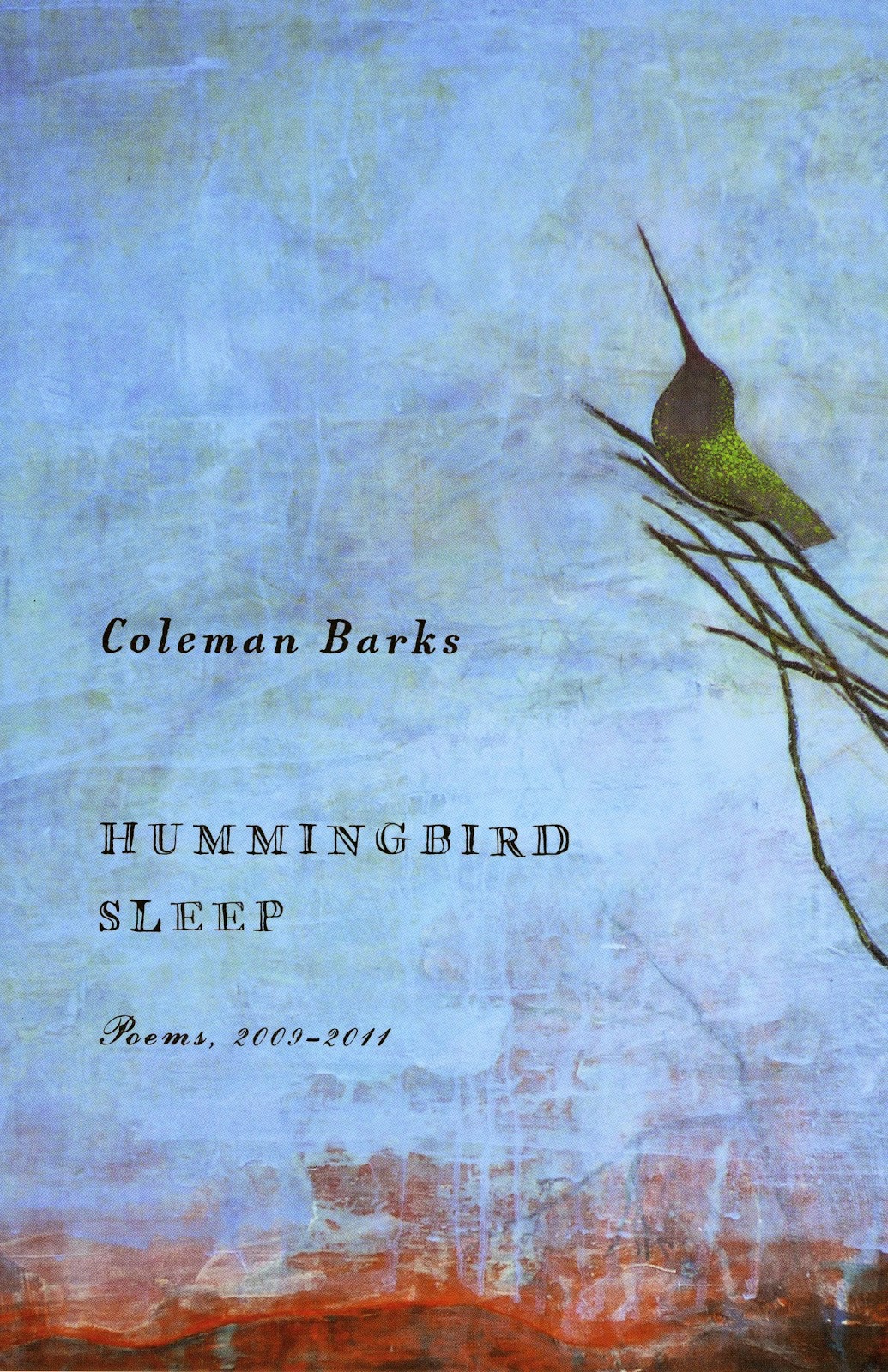
Continuing the celebration of National Poetry Month, Coleman Barks shares the poem "Hummingbird Sleep" that inspired the title of his latest poetry collection, HUMMINGBIRD SLEEP (2013, pg. 79).

Hummingbird Sleep
A hummingbird sleeps among the wonders.
Close to dark, he settles on a roosting limb
and lowers his body temperature
to within a few degrees of the air's own.

As the bird descends into torpor,
he assumes his heroic sleep posture,
head back, tilted beak pointing to the sky,
angling steep, Quixotic, Crimean.

This noctivation, the ornithologist word for it,
is very like what bears do through the winter.
Hummingbirds live the deep drop every night.
You can yell in his face and shake the branch.

Nothing. Gone. Where? What does he dream of?
He dreams he is the great air itself, the substance
he swims in every day, and the rising light
coming back to be his astonishing body.
About the Poem
I am told that the science here is accurate, that hummingbirds do go into a hibernative state each night. The poem is meant to celebrate the "deep drop" we all do each night that restores and renews us. The word "Crimean" may seem strange here, and oddly taken out of the current news. It refers to Tennyson's poem, "The Charge of the Light Brigade," and the hopeless heroism of those raised swords charging the cannons of the Russian positions.

About the Poet
Coleman Barks is the best-selling translator of The Essential Rumi The Soul of Rumi, and Rumi: The Book of Love and author of numerous volumes of poetry including Winter Sky: New and Selected Poems, 1968-2008 (Georgia). He taught creative writing and American poetry in the English Department at the University of Georgia for thirty years and currently lives in Athens, Georgia.

For more information about National Poetry month, visit www.poets.org. For more poetry from the UGA Press, visit the poetry section of our website here.

Thursday, April 03, 2014

Announcing the New Perspectives on the Civil War series

The University of Georgia Press is pleased to launch a new series on the American Civil War. New Perspectives on the Civil War is dedicated to the publication of primary sources of the Civil War era from a wide diversity of perspectives—respecting the soldier’s voice, but not privileging it over every other voice.

Much like the UnCivil Wars series which focuses on unconventional social types and less mainstream history, books in the New Perspectives on the Civil War series will highlight the many diverse voices from the Civil War era that need to be heard. Soldiers, civilians on the home front, slaves, political officials, government bureaucrats, newspaper correspondents, diplomats, and foreign observers all have a particular insight and deserve to have their stories told. The series will also seek to broaden the period of study beyond the 1861-1865 timeframe, recognizing that the attitudes that led to the war began years before the first shots were fired, and the repercussions of the war continued long after the surrender at Appomattox.

Through its unique approach on a popular topic, the books in the series will appeal to both scholars and general readers interested in the Civil War. The series will include a digital component to provide an enhanced experience for each volume to make them more appealing for classroom adoption.

Series editor Judkin Browning has a clear editorial policy. “All books will have introductions that place the letters in context, clear editorial methods, comprehensive annotations, full bibliographies, and intuitive indexes,” says Browning. “This will provide both consistency and high quality and set a level of excellence that scholars and general readers will come to expect.”

Series editor:
Judkin Browning is associate professor of history at Appalachian State University. He is the author of Shifting Loyalties: The Union Occupation of Eastern North Carolina and The Southern Mind Under Union Rule: The Diary of James Rumley, Beaufort, North Carolina, 1862-1865.

Contact info:
Judkin Browning: browningjj@appstate.edu

To inquire about publishing in the series, please contact:
Mick Gusinde-Duffy, editor-in-chief, the University of Georgia Press
mgd@ugapress.uga.edu

UGA Press
Founded in 1938, the UGA Press is the oldest and largest book publisher in the state. It has been a member of the Association of American University Presses since 1940. With a full-time staff of 26 publishing professionals, the press currently publishes 60-70 new books a year and has more than 1,800 titles in print. It has well-established lists in Atlantic World and American history, American literature, African-American studies, southern studies and environmental studies, as well as a growing presence in the fields of food studies, geography, urban studies, international affairs and security studies. For more information on UGA Press, see www.ugapress.org/

Wednesday, April 02, 2014

National Poetry Month: Week 1

Throughout the month of April, we will be celebrating National Poetry Month. Each week we will highlight one UGA Press poet and a poem from one of his or her books. Besides choosing the poem to showcase, each poet will provide some background information on the selected work.

To start off our poetry celebration, Idra Novey shares the poem "Aspect" from her book  EXIT, CIVILIAN (April 2012, pg. 13).

Aspect
For the aunt who only ate sugar packets from Applebee's,
we say poor Fay,
who didn't age well.

For the uncle who overdosed on stolen pills, we talk
of good Jerome,
who had too much sorrow.

Of the speeding tickets my father doesn't pay, he says honey,
out of state
may as well be fable.

About the night my mother spent in jail, we say nothing; once
my grandmother said imagine,
your pantyhose stripped in a hallway.

Of the fumbling years, all the waiting for her to look up again,
I say the rub
of my childhood, the thistle.

About the Poem
"Aspect" was one of the first poems I wrote for the book that would become EXIT, CIVILIAN. It took me two years to finish this poem, but once I did other poems came more quickly. I find certain poems are like that. They are keys and it takes incredibly long to get the grooves in them just right. Once that key poem is finished, however, you can get into the castle up into the turrets where all the other poems have been locked away and await their release.

About the Poet
Idra Novey is the author of The Next Country and has received awards from the Poetry Society of America, the National Endowment for the Arts, and the PEN Translation Fund. Her translations include Clarice Lispector’s The Passion According to G.H. (New Directions, 2012). She has taught in the Bard College Prison Initiative and in Columbia University’s School of the Arts.

For more information about National Poetry month, visit www.poets.org. For more poetry from the UGA Press, visit the poetry section of our website here.

Tuesday, April 01, 2014

Short Takes

Andrew Sullivan shares an excerpt from Kate Sweeney's AMERICAN AFTERLIFE on his blog, The Dish. The excerpt, with accompanying YouTube video, highlights Eternal Reefs, "a company that 'mixes the cremated ashes of your loved one with a cement compound to create part of an artificial coral reef.'"

On March 24, Ronald Angelo Johnson gave a talk on his book, DIPLOMACY IN BLACK AND WHITE, at the Pickering House in Salem, MA. The event was hosted by the Pickering House and the Salem Athenaeum. In its write-up about the event, the Boston Globe says it "drew a pack of dedicated history buffs, partly because it also featured a talk by Pickering family descendant Thomas R. Pickering, a former US ambassador to the United Nations who also served as ambassador to the Russian Federation, India, Israel, El Salvador, Nigeria, and Jordan."

James Marten, author of the forthcoming AMERICA'S CORPORAL, answers questions about James Tanner, the subject of his book, for the Civil War Monitor. Check out the video below for the full interview. Also pickup the spring issue of Civil War Monitor for Marten's article on Tanner.
In Sunday's Atlanta Journal-Constitution (subscription required), the "Personal Journeys" story about Robert Currey, a storehouse furniture founder, mentioned one of our books in the article:
Then came John McCown, a black activist who arrived in 1967 as executive director of the Georgia Council on Human Relations, a civil rights organization. Blacks considered him a savior; whites, a scoundrel, according to BLACK BOSS: POLITICAL REVOLUTION IN A GEORGIA COUNTRY written by John Rozier and published by the University of Georgia Press. Rozier credits McCown with transforming Hancock into the first black-controlled county in the United States since Reconstruction.

Michele Gillespie's KATHARINE AND R. J. REYNOLDS is a "well-researched joint biography," according to the Journal of Southern History. Gillespie "takes care to situate the couple in the economic, political, and social currents of their time . . . [she] informs readers about southern history and conveys appreciation for the lives of the couple."

A review by Hispanic American Historical Review says Robert J. Cottrol's THE LONG, LINGERING SHADOW has "made an immensely valuable contribution to analyses of racial formation and jurisprudence."

According to History: A Review of Books. Erica Ball's TO LIVE AN ANTISLAVERY LIFE "is a valuable addition to the cultural and intellectual history of antebellum America."